
What is the impact of different building forms on annual shaded hours?
Project Location: Zone 0A Extremely Hot Humid
Simulation Scale: Shoebox Model
Application: Conceptual
Audience: Academic
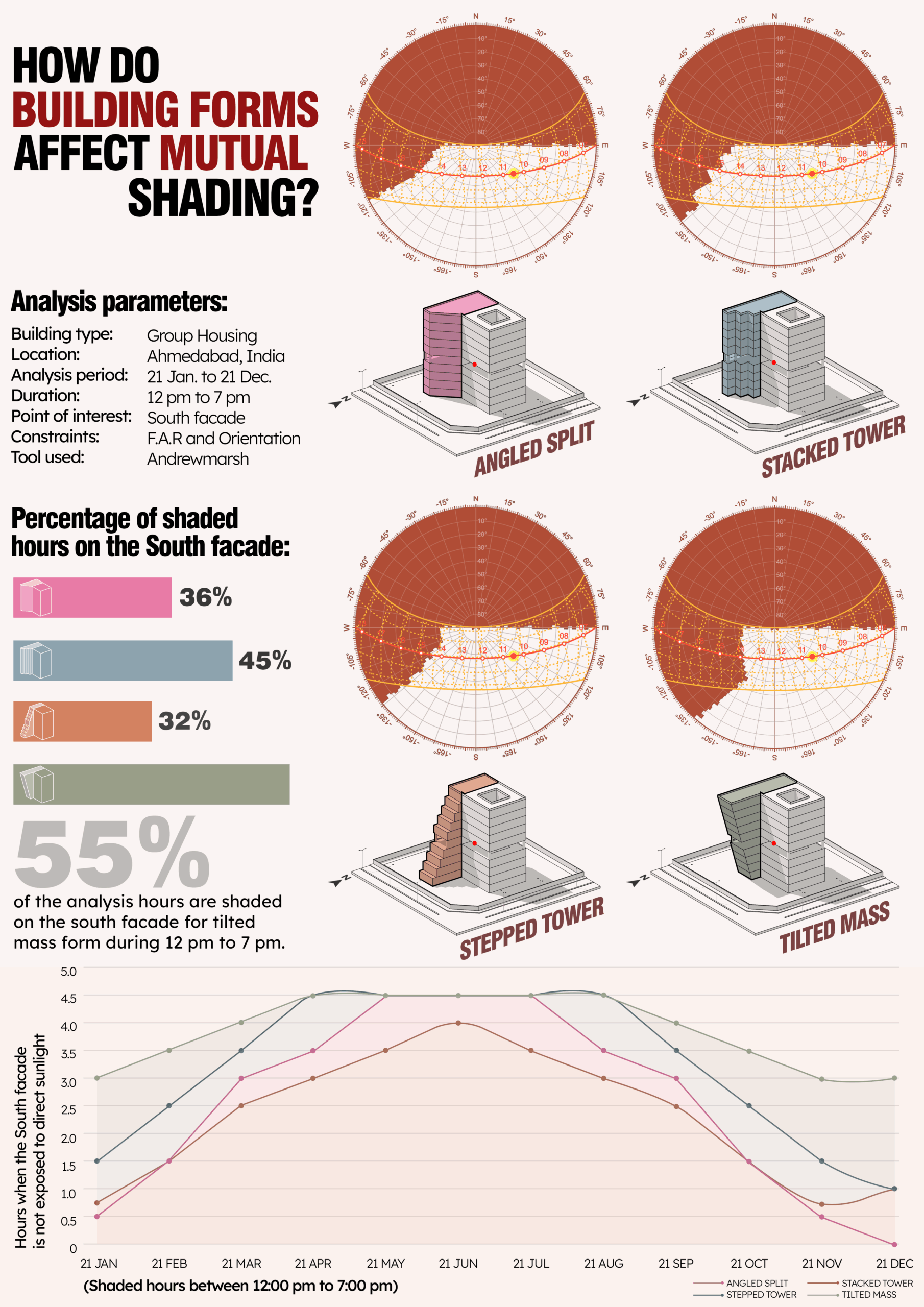
What is this graphic showing? Describe the different parts of the graphic and how it communicates the data.
Reducing solar heat gains during summer months is crucial in hot and dry regions in India. Hence, shading on the south is essential to keep buildings cool and reduce cooling loads. Based on this understanding, a study is done on 4 different group housing forms to study the effects of mutual shading on the south façade between 12 pm to 7 pm for a site in Ahmedabad as it remains predominantly hot throughout the year. Percentage of hours when the south façade is not exposed to direct sun is studied for these 4 forms for 21st of each month on Andrew marsh tool, and the results showed that Tilted-mass form provides maximum shading hours throughout the year as compared to any other form.
What type of graphic is this?
- Table / Chart
Design Variables
- Building Massing
What tools were used for the simulation analysis?
- Excel
- Ladybug Tools
What tools did you use to create the graphic?
- Adobe Photoshop
- Excel
- Grasshopper/Rhino
What was successful and/or unique about the graphic in how it communicates information?
The graphic combines sun path diagrams with massing views, enabling intuitive understanding of form and shading. Consistent solar analysis across four forms allows quick visual performance comparison. A line graph links temporal variation to each form, reinforcing annual impact. This layered yet clear visual storytelling makes complex simulation outputs accessible and design-relevant.
Is there anything else you would like to mention?
This analysis can be extended by linking shading results to cooling load simulations, thermal comfort analysis, and energy use intensity (EUI). Incorporating daylighting and glare metrics would provide a more holistic view of façade performance. Future work could also explore optimization algorithms to balance form, shading, and energy performance.